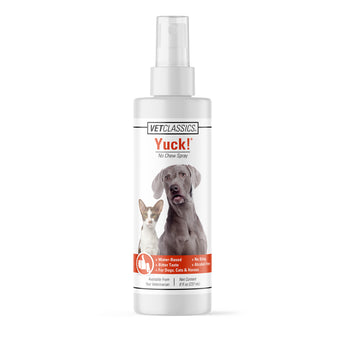
No Chew Spray for Dogs, Cats and Horses
VetClassics YUCK!® No Chew Spray is an 8 oz bitter-tasting deterrent spray designed to help discourage unwanted chewing and licking in dogs, cats, and horses. The clear, water-based formula contains a bittering agent that makes treated surfaces unpleasant to taste, helping pet owners support training and redirect chewing toward more appropriate toys and objects.
YUCK!® can be used on a variety of washable surfaces and targeted areas, including furniture, wood, drapes, bandages, paws, tails, and other items pets may repeatedly chew or lick. The alcohol-free formula is designed for a no-sting application and can be used indoors or outdoors according to the product directions.
Because chewing is a normal animal behavior, YUCK!® works best as a training aid rather than as a substitute for appropriate toys, enrichment, supervision, or veterinary care when persistent chewing has an underlying cause.
Bitter-Tasting Chewing Deterrent Spray
The key feature of YUCK!® No Chew Spray is its unappealing bitter taste. When a pet attempts to chew or lick a treated surface, the taste helps make that particular object less desirable.
This gives owners a practical tool for managing unwanted chewing while teaching the animal which items are appropriate to chew. The spray itself does not eliminate the natural chewing instinct. Instead, it helps make selected objects less rewarding while training and appropriate alternatives are provided.
Pets differ in taste preferences and behavior, so individual responses can vary. Monitor your pet after the first application and confirm that the bitter taste actually discourages the behavior before leaving the animal alone with the treated object.
No Chew Spray for Dogs
YUCK!® can be used as a no chew spray for dogs when unwanted chewing becomes a problem around the home or on accessible areas such as paws, bandages, or tails.
Dogs may chew objects for many reasons, including exploration, teething, boredom, normal play, environmental change, or simply because an object is rewarding to chew. YUCK!® helps owners make selected items less appealing while redirecting the dog toward appropriate chew toys.
For best results, combine the deterrent with consistent training. Remove or protect unsafe items whenever possible and give the dog appropriate alternatives rather than relying on bitter spray as the only behavior-management tool.
No Chew Spray for Cats
The current YUCK!® label also identifies the product for cats. It can be applied to appropriate washable surfaces or other labeled areas when a cat repeatedly chews or licks something that should be left alone.
As with dogs, monitor the cat's response to the first application because taste preferences vary between animals. A bittering spray may discourage one pet strongly while another may require additional environmental management or training.
Do not spray around the eyes or nose, and use the product only according to the current label instructions.
No Chew Spray for Horses
YUCK!® is also labeled for horses. The product can be used on appropriate targeted areas and washable surfaces when unwanted chewing needs to be discouraged.
The current product label specifically includes tails and manes among the areas associated with use. Application should remain controlled, and contact with the eyes and nose should be avoided.
For persistent or unusual chewing behavior in a horse, professional veterinary or behavioral guidance may be appropriate rather than relying only on a topical deterrent.
Water-Based and Alcohol-Free Formula
YUCK!® uses a water-based, alcohol-free formula. The current ingredient list contains only Deionized Water, Bittering Agent, and Citric Acid.
This simple formulation is one of the product's clearest differentiators. It does not rely on a strong fragrance or alcohol base to create its deterrent effect. Instead, the bitter taste is the primary mechanism used to make treated objects less appealing.
The alcohol-free design is also part of the product's no-sting positioning. Always follow the current label directions and discontinue use if an unexpected reaction occurs.
Simple Three-Ingredient Formula
The verified YUCK!® ingredient list is:
- Deionized Water
- Bittering Agent
- Citric Acid
The short ingredient list makes it easy to distinguish YUCK!® from training sprays that contain fragrances, essential oils, alcohol, or more complex ingredient systems.
The bittering agent is responsible for the unpleasant taste that helps discourage chewing and licking on treated items.
Anti-Chew Spray for Furniture and Household Items
YUCK!® can be used as an anti-chew spray for washable household surfaces. The current label includes furniture, drapes, wood, and other appropriate objects pets may repeatedly chew.
This makes the spray useful during training when a dog or other pet has developed interest in household items that are not intended for chewing. Apply the spray evenly to the selected surface and use it consistently while the unwanted habit is being addressed.
The product is designed to be non-staining, but surfaces and finishes can vary. Always test a small, inconspicuous area before applying the spray more broadly, particularly on fabric, finished wood, or valuable household items.
Using YUCK!® on Paws, Tails and Bandages
The current label also permits YUCK!® to be used on areas such as paws, tails, manes, bandages, and other targeted locations when licking or chewing needs to be discouraged.
The purpose of application is behavioral deterrence. YUCK!® should not be described as treating the underlying reason a pet is licking a paw, chewing a tail, or bothering a bandage.
If a pet repeatedly focuses on one body area, especially when redness, swelling, hair loss, pain, discharge, or skin damage is present, veterinary evaluation may be needed to identify the reason for the behavior.
Can Be Used Over Topical Medication
VetClassics states that YUCK!® may be sprayed over topical medication. This can be useful when an animal needs additional discouragement from licking or chewing a treated area.
The spray should still be used according to both the YUCK!® label and any instructions associated with the topical medication. When the pet is under veterinary treatment, ask the veterinarian if there are questions about combining products on the same area.
The role of YUCK!® remains chewing and licking deterrence rather than contributing a separate therapeutic action.
Use on or Around Plants
Current VetClassics labeling also states that YUCK!® is suitable for use on or around plants. This can provide another training option when a pet repeatedly mouths or chews vegetation in appropriate household or outdoor areas.
Plant safety and pet safety are separate considerations. Even if the deterrent itself is approved for use around plants, owners should still make sure the plant species itself is safe for the animal to access.
If a pet has consumed a plant that may be toxic, contact a veterinarian or appropriate animal poison resource rather than relying on a deterrent spray after exposure.
How to Apply YUCK!® No Chew Spray
Spray YUCK!® evenly over the surface or area you want the pet to avoid chewing or licking. The current directions include use on furniture and other labeled areas and advise using the spray consistently until the undesirable habit is curtailed.
Do not spray around the eyes or nose. When treating a household surface, test a small hidden area first to confirm compatibility.
Reapply as needed when the deterrent effect is no longer sufficient or after a treated surface has been cleaned. There is no need to create a fixed reapplication schedule if the current condition of the treated area does not require it.
Use YUCK!® as Part of a Training Routine
YUCK!® is best understood as a behavior and training aid. The bitter taste helps make selected objects less attractive, while the owner teaches the pet what it should chew instead.
Provide appropriate chew toys, enrichment, supervision, and consistent redirection alongside the spray. If a dog begins chewing a piece of furniture, for example, the goal is not simply to make the furniture taste bad. The dog should also be shown an appropriate object that satisfies the normal urge to chew.
This combination of deterrence and redirection generally creates a clearer training message than using a bitter spray without providing an alternative.
Why Pets May Continue Chewing
Chewing is a natural behavior, and not every pet responds the same way to a bitter taste. Some animals may immediately avoid the treated object, while others may be more persistent.
For that reason, VetClassics advises monitoring the animal's response to YUCK!®. Confirm that the taste is actually acting as a deterrent before relying on the product when the pet is unsupervised.
Persistent chewing can also reflect insufficient enrichment, normal developmental behavior, environmental stress, access to inappropriate objects, or other factors. A successful management plan may need to address those factors as well as the object itself.
YUCK!® Compared With General Pet Repellent Sprays
A no-chew spray and a general pet repellent spray are not necessarily the same product type. YUCK!® works primarily through taste deterrence. The animal encounters an unpleasant bitter taste after licking or chewing the treated area.
Other deterrent products may rely on scent, sound, motion, or other behavior-management methods. Those products should not automatically be considered substitutes because their intended application and mechanism may be different.
YUCK!® is most relevant when the goal is specifically to discourage chewing or licking of a treated surface.
YUCK!® Compared With Skin-Care Sprays
Although YUCK!® can be applied to labeled body areas, it should not be confused with a medicated dermatology spray. Its purpose is to discourage chewing and licking, not to treat an underlying skin condition.
Stratford carries separate topical products designed around dermatological ingredients and skin-care needs. Those products should retain treatment-specific or skin-support intent, while YUCK!® remains focused on behavioral deterrence.
This distinction is also important for search visibility. Someone looking for a bitter anti-chew spray belongs on the YUCK!® page, while someone looking for a medicated spray should be directed to the appropriate dermatology product.
Clear, Non-Sticky and Designed Not to Stain
VetClassics describes YUCK!® as a clear, non-sticky formula designed not to stain. These features are useful when a deterrent needs to be applied to household items as well as certain animal-care areas.
Because materials and finishes vary, the label still recommends testing an inconspicuous area before broader application. This is especially important for delicate fabrics, wood finishes, or surfaces where discoloration would be difficult to correct.
Following that simple spot-test step can help owners use the spray more confidently around the home.
8 oz Spray Bottle for Targeted Application
YUCK!® No Chew Spray is supplied in an 8 fl oz (236 mL) spray bottle. The spray format allows the product to be applied directly to selected objects and targeted areas without preparing or diluting a separate solution.
Keep the bottle in its original packaging so the ingredient list, directions, cautions, and product information remain available throughout use.
Store it out of reach of children and pets when it is not being applied.
When Veterinary or Behavioral Guidance Is Appropriate
YUCK!® is intended as a training aid for unwanted chewing and licking. It should not replace veterinary evaluation when a pet repeatedly focuses on one body area, damages its own skin, suddenly develops unusual chewing behavior, or shows other signs of discomfort.
Professional behavioral guidance may also be appropriate when destructive chewing is persistent despite environmental changes, appropriate toys, supervision, training, and deterrent use.
When used according to the current label, VetClassics YUCK!® No Chew Spray provides dogs, cats, and horses with a water-based, alcohol-free bitter deterrent that helps discourage unwanted chewing and licking on treated items while supporting a consistent training routine.