Digestive Clay Powder for Dogs and Cats with Hydrated Calcium Aluminosilicate
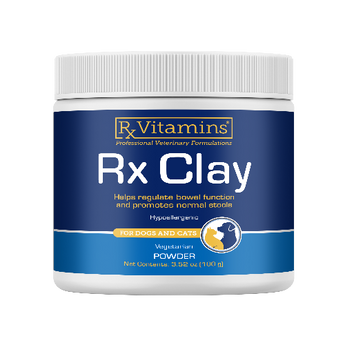
RX Vitamins RX Clay is a 100 g digestive support powder for dogs and cats formulated with Hydrated Calcium Aluminosilicate Clay. Designed to help maintain normal bowel function, healthy stool quality, and normal gastrointestinal function, RX Clay provides a simple single-ingredient powder that can be measured according to body weight and incorporated into a pet's digestive wellness routine.
Each level scoop contains 500 mg of Hydrated Calcium Aluminosilicate Clay, with no inactive ingredients listed in the current product facts. RX Clay is also identified as vegetarian and hypoallergenic. The powder is sterilized and processed to support easy dispersion, giving pet owners and veterinary professionals a clearly defined digestive clay formula without added probiotics, enzymes, flavors, or additional nutritional ingredients.
RX Clay is formulated for digestive and bowel support rather than general vitamin supplementation. Its defining characteristics are the Hydrated Calcium Aluminosilicate Clay ingredient, powder format, weight-based directions, normal stool-quality positioning, and suitability for both dogs and cats.
Hydrated Calcium Aluminosilicate Clay for Digestive Support
The active ingredient in RX Clay is Hydrated Calcium Aluminosilicate Clay. Each level scoop provides 500 mg, making the amount per serving easy to identify when following the product directions for dogs and cats.
Hydrated Calcium Aluminosilicate is the central product entity behind RX Clay and distinguishes it from other digestive supplements that rely on probiotics, prebiotics, enzymes, fiber, botanical ingredients, or nutritional blends. Pet owners searching for a digestive clay for dogs or cats should therefore recognize RX Clay as a specific calcium aluminosilicate powder rather than a generic gastrointestinal supplement.
The formula contains no listed inactive ingredients. This straightforward composition can also make product comparison easier because the digestive-support ingredient and amount are clearly defined rather than being part of a large multi-ingredient blend.
Supporting Normal Bowel Function and Stool Quality
RX Clay is formulated to help support normal bowel function and maintain normal stool quality. These are the primary digestive-care purposes Stratford currently associates with the product and should remain the focus of its use rather than broader claims about treating gastrointestinal disease.
Changes in stool consistency can occur for many reasons, including temporary dietary changes, environmental factors, travel, stress, or other digestive influences. A digestive-support powder can be one part of a pet's care routine when helping maintain normal bowel function is appropriate.
Persistent digestive changes, however, should not automatically be managed with supplementation alone. Repeated loose stools, vomiting, appetite changes, blood in the stool, significant discomfort, or other ongoing gastrointestinal signs may require veterinary evaluation to determine the appropriate course of care.
A Single-Ingredient Digestive Clay Powder
RX Clay differs from many gastrointestinal supplements because it uses a single active ingredient. The current product facts list Hydrated Calcium Aluminosilicate Clay at 500 mg per scoop and list no inactive ingredients.
This is useful for pet owners comparing several digestive-support options. A probiotic product may be selected for intestinal microflora support, an enzyme supplement may be used as part of a digestive enzyme routine, and a fiber product may have another nutritional role. RX Clay instead provides a mineral clay-based powder centered on normal bowel and stool-quality support.
Keeping those product categories separate helps owners choose products based on what they actually contain instead of assuming every supplement in a gastrointestinal collection serves the same purpose.
RX Clay for Dogs
RX Clay can be used for dogs according to its weight-based product directions. Searches such as RX Clay for dogs, clay powder for dogs, and digestive clay for dogs reflect one of the strongest commercial opportunities currently associated with the product.
For dogs, serving amounts are based directly on body weight. This makes accurate weight important when determining how much powder to use. Owners should use the included level scoop and follow the current package directions rather than estimating an amount with an unrelated measuring utensil.
A dog's digestive routine may also involve diet, hydration, other supplements, medications, and veterinary recommendations. If RX Clay is being used alongside another gastrointestinal product, review the complete care plan with a veterinarian when appropriate rather than assuming that multiple digestive supplements should automatically be combined.
RX Clay for Cats
RX Clay is also positioned by Stratford for cats, making it relevant for owners searching for digestive clay for cats or a calcium aluminosilicate clay powder for feline gastrointestinal support.
The powder format can be helpful when a pet owner prefers a measured product rather than a chew or capsule, but correct administration remains important. Follow the current label directions and any veterinary instructions provided for the individual cat.
Cats can develop digestive changes for many different reasons, so recurring loose stool, repeated vomiting, refusal to eat, weight loss, lethargy, or unusual behavior should not simply be attributed to a need for digestive supplementation. Veterinary evaluation is appropriate when signs persist or become more pronounced.
500 mg of Calcium Aluminosilicate Clay Per Scoop
Each level scoop of RX Clay contains 500 mg of Hydrated Calcium Aluminosilicate Clay. Making this amount prominent helps shoppers evaluate the product more accurately than relying only on the total bottle weight.
The bottle contains 100 grams of powder, while the individual serving amount is defined by the 500 mg scoop. The correct number of scoops then depends on body weight and whether the product is being given according to the current label's temporary-use or maintenance directions.
This distinction is important because a 100 g container describes how much product is in the package, while 500 mg describes the amount of active ingredient provided by one level scoop.
Weight-Based Directions for RX Clay
RX Clay has specific body-weight directions rather than a single amount for every pet. The current label directs owners to give one level scoop (1/8 teaspoon) for every 10 pounds of body weight, twice daily, when diarrhea is present.
For maintenance use, the label directs one level scoop for every 25 pounds of body weight, or use as directed by a veterinarian.
Because these instructions use two different weight ratios depending on the situation, owners should read the package carefully rather than applying the maintenance amount to every circumstance. Do not increase the serving, change the frequency, or substitute directions from another clay supplement without appropriate guidance.
If a veterinarian has provided a different plan for an individual dog or cat, follow that professional recommendation.
100 g Powder Format for Measured Administration
RX Clay is supplied as a 100 g (3.52 oz) powder. The loose powder format allows servings to be measured according to the pet's body weight rather than requiring a fixed tablet or capsule size.
For households with pets of different sizes, a measured powder can offer flexibility while still requiring careful adherence to the label. The included level scoop provides the reference amount used in the product directions.
Keep RX Clay in its original container so the serving information, ingredient panel, cautions, lot information, and product instructions remain available. The original packaging also helps distinguish it from other powdered gastrointestinal supplements that may use different serving sizes or ingredients.
Vegetarian and Hypoallergenic Formula
The current RX Clay label identifies the product as vegetarian and hypoallergenic. Combined with the single listed active ingredient and absence of inactive ingredients, this gives the product a particularly simple formulation profile.
These characteristics can be useful when comparing digestive products that contain animal-derived flavors, multiple botanical ingredients, probiotics, prebiotics, or other components. They do not mean that every animal will respond to the product in the same way or that veterinary guidance is unnecessary when a pet has an ongoing gastrointestinal concern.
Product selection should still be based on the pet's individual needs, the reason digestive support is being considered, and the current directions provided with the product.
Sterilized Powder with Controlled Particle Size
Stratford states that RX Clay is sterilized and ground to an 80-micron particle size to support dispersion of the powder. The company also states that the current formula is free from heavy-metal contamination and contains no available aluminum.
These manufacturing details help differentiate RX Clay from simply purchasing an unspecified clay material. Pet supplements should be evaluated as finished products with defined manufacturing and quality specifications rather than assuming that any mineral clay is equivalent to a veterinary-formulated product.
Pet owners should use RX Clay itself and should not substitute household, cosmetic, industrial, or other non-pet clay products based solely on the presence of a similar mineral name.
RX Clay Compared With Probiotic Powders
RX Clay and probiotic supplements may both appear in digestive-health collections, but they are different product types. RX Clay contains Hydrated Calcium Aluminosilicate Clay, while a probiotic product supplies beneficial microorganisms and may also contain prebiotic ingredients.
For example, Stratford's RX Biotic is a probiotic and prebiotic powder formulated around intestinal microflora support. RX Clay does not list probiotic bacterial strains and should not be described as a probiotic.
This distinction helps owners choose products based on verified formulation. Someone specifically looking for digestive clay or calcium aluminosilicate belongs on the RX Clay page, while someone looking for probiotic and prebiotic support should evaluate a probiotic formula instead.
RX Clay Compared With Digestive Enzyme Supplements
RX Clay is also different from a digestive enzyme supplement. Its ingredient panel does not list digestive enzymes. The product's role is centered on Hydrated Calcium Aluminosilicate Clay, normal bowel function, and stool-quality support.
Digestive enzyme products have their own ingredient systems and should retain that separate search intent. This is important because broad gastrointestinal terminology can make products appear interchangeable when their formulas and purposes are actually quite different.
To compare different formats and approaches, explore Stratford's digestive health supplements for dogs and cats.
Using RX Clay as Part of a Broader Digestive Wellness Routine
Digestive wellness is influenced by more than one product. Diet, access to fresh water, feeding consistency, activity, environmental changes, medications, and underlying health can all affect normal gastrointestinal function and stool quality.
RX Clay can fit into this broader routine when a Hydrated Calcium Aluminosilicate powder is appropriate. It should not be expected to replace good nutrition, hydration, veterinary evaluation, or other parts of a pet's health plan.
When several supplements are being used at the same time, owners should keep track of ingredients and administration times and discuss the complete routine with a veterinarian when needed. This is particularly important for pets receiving prescription medication or being managed for an ongoing health concern.
Choosing a Digestive Clay Based on Verified Product Information
Searches for digestive clay, clay powder for dogs, or clay for cats can return products with very different compositions and intended uses. The safest way to compare them is to look at the actual ingredient, amount per serving, species information, manufacturing details, and directions.
RX Clay provides a clear specification: 500 mg Hydrated Calcium Aluminosilicate Clay per level scoop, no listed inactive ingredients, 100 g powder size, dog-and-cat positioning, and body-weight-based administration.
These verified product details are more useful than broad promises about detoxification or gastrointestinal treatment. They allow shoppers to understand what RX Clay is, how it differs from probiotics and enzyme supplements, and where it may fit into a pet's normal digestive-support routine.
Veterinary Guidance and Important Cautions
The current RX Clay label recommends a veterinary examination before using the product. Safe use in pregnant animals or animals intended for breeding has not been proven.
If your pet's condition worsens or does not improve, stop administering the product and consult your veterinarian. Persistent diarrhea, repeated vomiting, blood in the stool, significant loss of appetite, unexplained weight loss, marked lethargy, abdominal discomfort, or recurring gastrointestinal changes should receive veterinary attention rather than being managed solely with an over-the-counter digestive supplement.
RX Clay is for animal use only and should be kept out of reach of children and other animals. In case of accidental overdose, contact a health professional immediately.
When used according to its current label and veterinary guidance, RX Vitamins RX Clay 100g Powder provides dogs and cats with a simple digestive clay formula containing Hydrated Calcium Aluminosilicate Clay to help support normal bowel function, healthy stool quality, and normal gastrointestinal wellness.




 Eligible
 Supports normal bowel function and digestive health
 Authentic products from trusted brands
 Free shipping on all consumer purchases
 Active Offer


